
Identify a Butler County Property Owner
Ownership in Butler County lives in two records. The PVA qPublic search ties an address to an owner-for-tax line and map number. The Clerk's recorded index is the other half. Check both before treating a name as current.
- Search the location address in qPublic and save the full map number, owner text, and legal-information clues.
- Search that owner as a recent grantee in eCCLIX. Match the map or legal description, not just the name.
- If the deed names an LLC, check the Kentucky business record for the entity's filed identity and status.
- Use the mailing address only for a lawful property inquiry. It does not prove where a person lives.
Butler Ownership Has a Date
Butler County fixes tax ownership on January 1. That date is the PVA's rule. A sale that closes later can leave the former owner on that year's tax bill. The office tries to send the bill to the buyer using the recorded deed. But that mailing step never turns the roll into a real-time title register.
This quirk explains many apparent conflicts. For a post-January transfer, the newest deed's grantee shows the chronology better. A tax row can still carry the old name. The roll stays useful for one reason. It binds the name, map number, address, and assessment to one parcel.
Note: Record the effective date of each source before deciding who owns the Butler County property now.
Sources Behind Butler County Ownership
Each Butler County source answers one narrow question. qPublic reports ownership for tax administration. The Clerk records the instruments. State business filings identify a legal entity, while state GIS supplies broad geographic context. None should be stretched beyond its role.
| Source | Owner Info It Gives | Access |
|---|---|---|
| PVA tax roll | Owner-for-tax, address, map and assessment clues | qPublic, phone, mail, or counter |
| County Clerk index | Newest deed's grantor, grantee, and reference | eCCLIX or Clerk counter |
| Secretary of State | Entity status and filed business details | Online business search |
| Kentucky GIS | Road, city, stream, and boundary context | KYGeoNet map services |
The owner is not the occupant. A mailing address can be a post office box or any address chosen for tax notices. A situs address identifies the parcel itself. Neither field proves a named person is physically present.
Confirm Butler Ownership by Deed
The Butler County Clerk records deeds, mortgages, easements, plats, liens, and releases. Its records page points to eCCLIX. Free searching has limits. Noncommercial users may run five Butler searches a day at no charge, while document images require subscription access.
Start with the grantee. Search the apparent owner's name in the grantee index and favor recent dates. Then open or request the deed. Compare its legal description with the PVA parcel. The parcel must match. If online access fails, call the Clerk at 270-526-5676, mail P.O. Box 449, Morgantown, KY 42261, or visit the 110 N. Main Street counter during published weekday hours. Those routes matter when the index is incomplete or an image is gated.
Trace a Butler LLC Owner
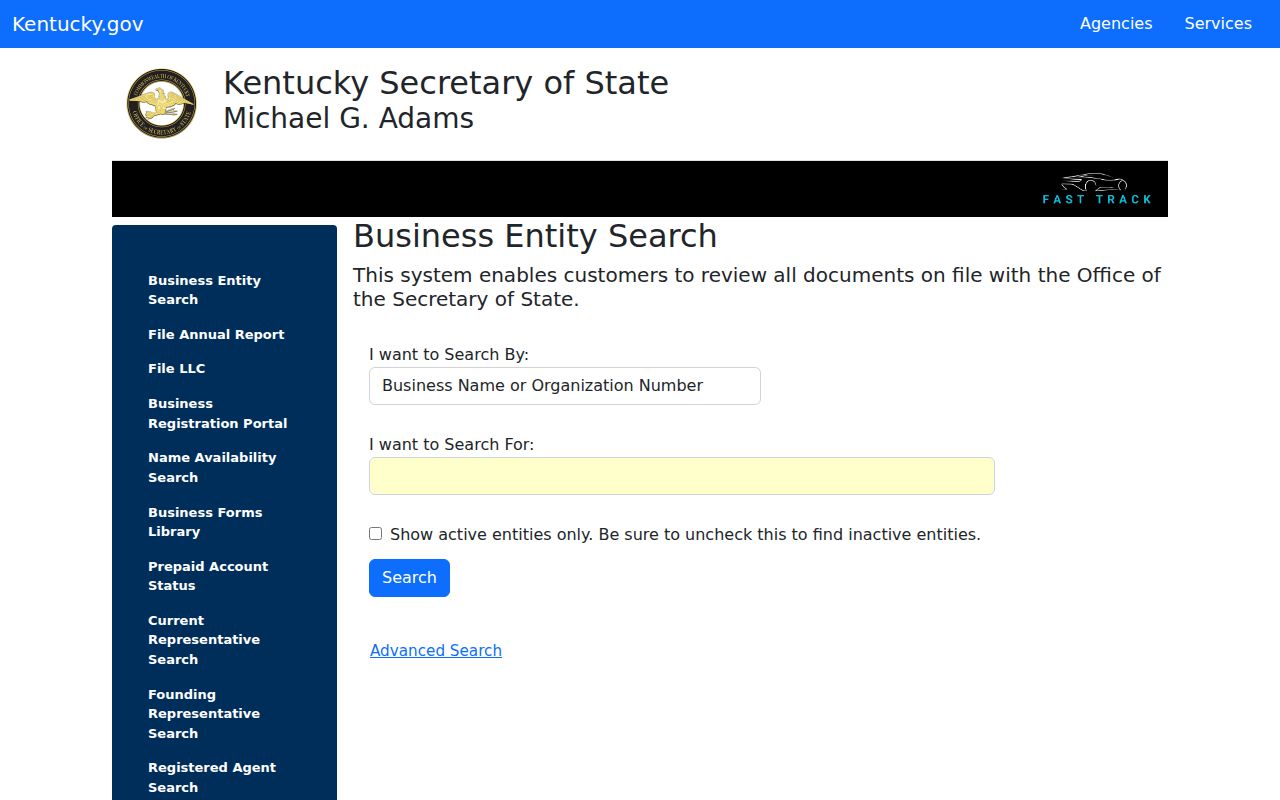
An LLC can be the true grantee. Search the deed name exactly in the Kentucky Business Entity Search. The interface uses a search-key dropdown, a text field, and an active-only control. Uncheck active-only for older entities.
The official Kentucky business search screen shows the entity lookup fields used after a Butler County property owner search.
A registered agent or principal-office filing helps identify the company. It does not prove the company owns the parcel. Only the recorded conveyance, matched to the legal description, answers that question.
Read Trust and Estate Names
A trust, estate, executor, administrator, or surviving joint owner may appear in Butler records. Preserve the exact role. Search the deed index for an executor's deed, administrator's deed, affidavit of descent, will-related instrument, trust deed, or later conveyance. The probate docket may explain authority. The recorded instrument still shows what was placed against the parcel description.
A common name needs the same care. Compare the parcel map number, legal description, address, and recording sequence. Initials and spelling variants help locate an index entry. A surname alone is not a match.
Probate adds a second record system. CourtNet can identify a Butler case by party and case information, but the courthouse file holds the appointment, will, inventory, sale order, or settlement. Search the decedent's full name, initials, married name, and an "Estate of" form, then return to the Clerk index to see whether an executor's deed, administrator's deed, affidavit of descent, or other instrument was actually recorded for the parcel.
Do not assume the estate's administrator became the owner. Executor, administrator, trustee, beneficiary, and surviving joint owner are different roles. Record the caption and instrument type exactly. A probate case explains authority for a transfer, while the legal description in the recorded instrument establishes which land the filing concerns. Historical research can need a longer chain. Butler deed books begin in 1810. FamilySearch indexes run from 1795 through 1912. KDLA holds deed and will series on microfilm. The local library can help with newspapers, obituaries, maps, and family files. Those sources build identity clues. They do not replace the current deed when the question is who owns the land now.
DocAlert Watches Butler Names
The Clerk's records page links DocAlert. It is a free name and email notification service. An alert can flag a later filing under a person or a business without proving that title changed or that the filing touches any one parcel. Match every notice to the legal description and the underlying instrument before drawing a conclusion.
Butler Tax Lists Prove Less
Butler County's delinquent tax list carries a bill number, map number, name, and property address. It also shows the account balance. That is where its value stops. It holds no deed book and page. It also offers no certified ownership finding or proof a balance remains unpaid. Treat the map number as a search key. Then return to the PVA and the newest deed.
One published row shows why exact identifiers matter. Decimal punctuation and endings such as MH can appear in Butler map numbers. Save the full string. Trim part of it and the next search strays onto a different tax parcel. The printed name belongs to that dated delinquency record. It is not an independent declaration of present title.
If the address search fails, try the owner's exact recorded form. Also try a shortened rural road phrase and the legal-information mode. Carry that map number into the deed index. The cross-reference beats broad name matching. It keeps the ownership question attached to the land. Should no online route work, ask the PVA and Clerk counters to search their own public systems. Do not guess from a commercial compilation.
Limits on Butler Owner Research
Public land records can name the owner of record. They cannot prove occupancy, present location, or family relationships. Nor can they expose hidden title defects sitting behind an index entry. A delinquency list is only a dated balance snapshot. Kentucky's Safe at Home program shields many agency addresses, though state guidance treats real-estate holdings as an exception to substitution.
Use official channels and verify dates. A certified record is not a title opinion. Nor is a map a survey. Deeper present-owner review belongs in the Butler County current owner lookup.
For a purchase or easement question, save the qPublic result date, the full parcel number, and the recording reference for the newest matching deed. Ask the Clerk for the underlying image when eCCLIX shows only index data. If legal descriptions do not match, stop. Resolve the mismatch through the Clerk, the PVA, a title professional, or a licensed surveyor. A similar address, a split tract, or a partial interest can otherwise masquerade as the answer to who owns the whole Butler County property. Careful matching keeps claims tied to the land.
Lawful use. Butler County owner records support purchase diligence, estate work, and boundary questions. Never use them to stalk, harass, or target anyone.